
October 2, 2026

Off-grid on the Winter Solstice in Rural WA
What a PowerMuster Farm system actually delivered on a working farm in the WA Midwest — no use of the grid, no use of the backup generator, with typical cloud cover on the shortest day of 2026.
These are real, unedited telemetry figures logged from a PowerMuster Farm system on a working farm in Western Australia’s Midwest, captured on 22 June 2026 — the winter solstice, and the shortest day of the year. The sky was overcast for most of the morning. The grid is not connected. Everything you’re about to read happened on solar and battery alone.
The property
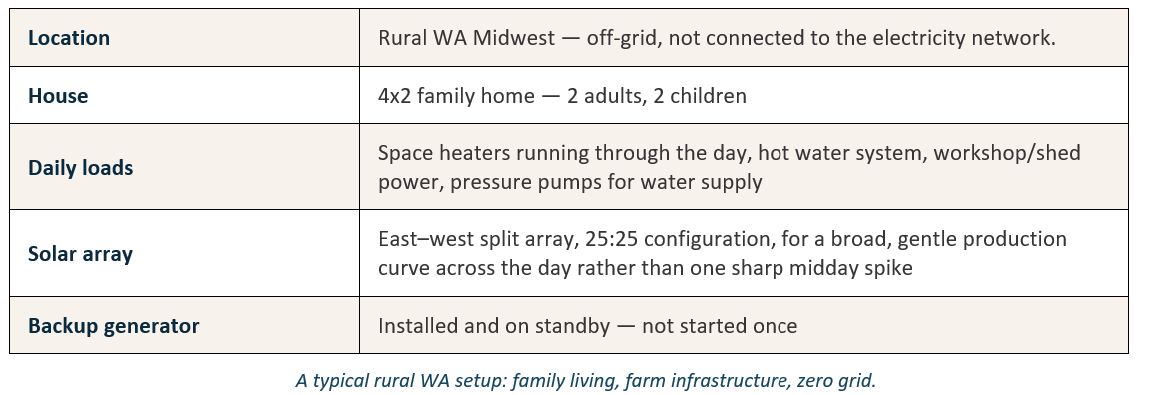
It’s a modest, ordinary rural household — the kind PowerMuster is built for, not a best-case showcase:
The shortest, cloudiest day of the year
Winter solstice mornings in the Midwest start cold and dark, and this one stayed overcast well past sunrise. Overnight, the house ran on battery alone — heaters, hot water recovery and the usual background load pulled the battery down from 73% to a low of 47% just before 8 am, right as the household’s own morning peak (heaters, kettles, kids getting ready) pushed consumption to 5.8 kW.
From there, the array did the work. Even through cloud, production climbed steadily through the morning, and the battery bank was completely full — 100% state of charge — by 10:55 am. From that point on, the system had nothing left to prove; production eased back to match the house load exactly, any midday farm activity (shed, pumps, tools) was absorbed straight out of a full battery, and the reserve sat at 100% for the rest of the afternoon.
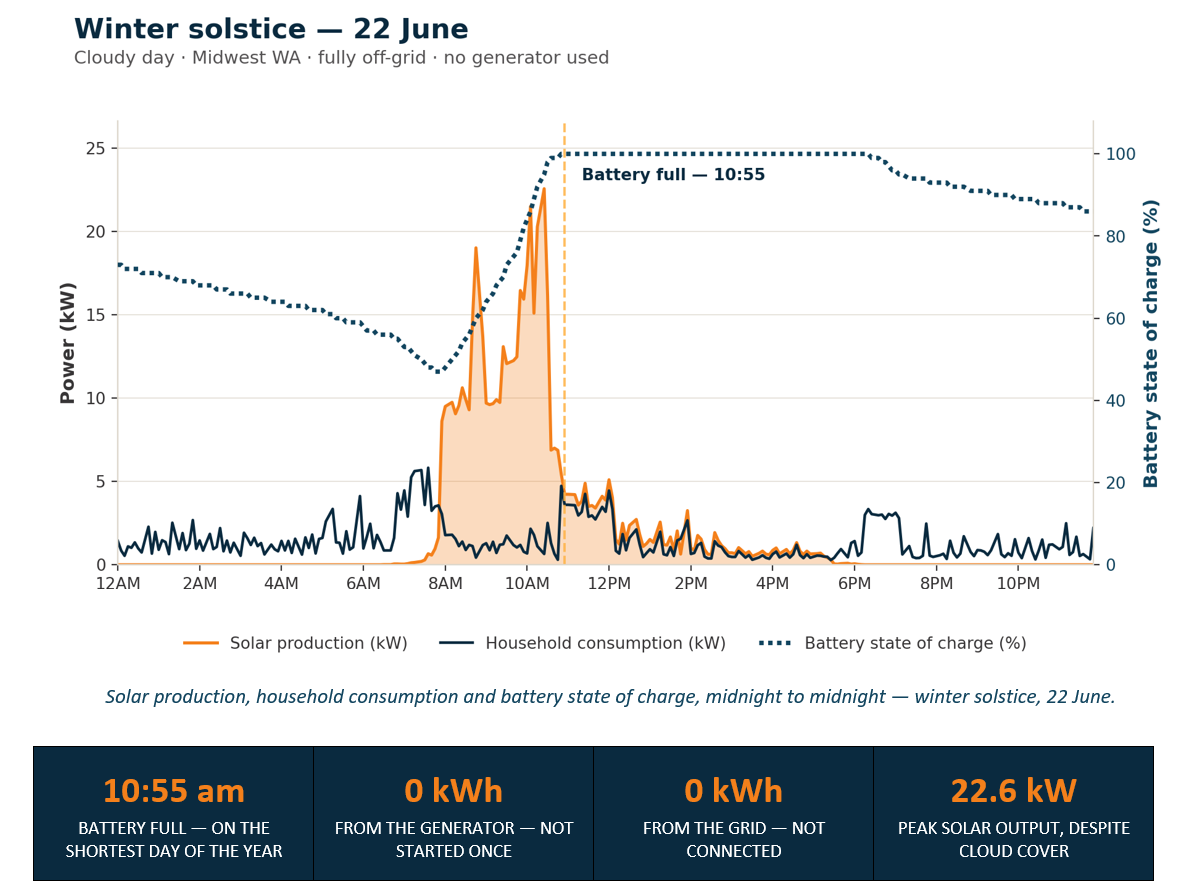 By the time the sun set, the home had produced roughly 49.5 kWh against about 34.4 kWh consumed — a comfortable surplus, on the one day of the year when solar has the least to work with. The battery finished the day (official sunset) at 86% state of charge; plenty in reserve overnight, without the generator ever being asked to run.
Two months later — the same farm, getting stronger.
The same system, the same house, the same family — just two months further from the solstice, on 26 August. The days are getting longer, and the sun sits higher, and it shows up directly in the numbers. This wasn’t a mild day either: the household actually drew more power that day (about 41.4 kWh across 24 hours, versus 34.4 kWh on the solstice), yet the system still filled the battery faster and produced more peak power.
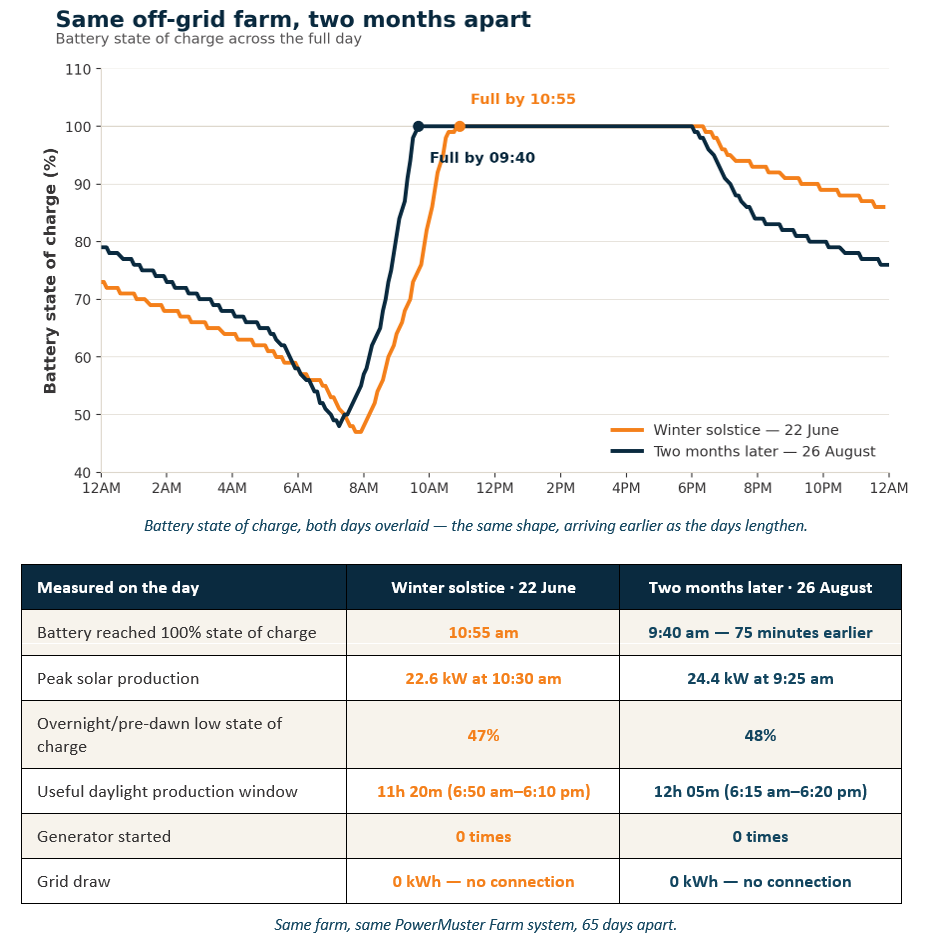
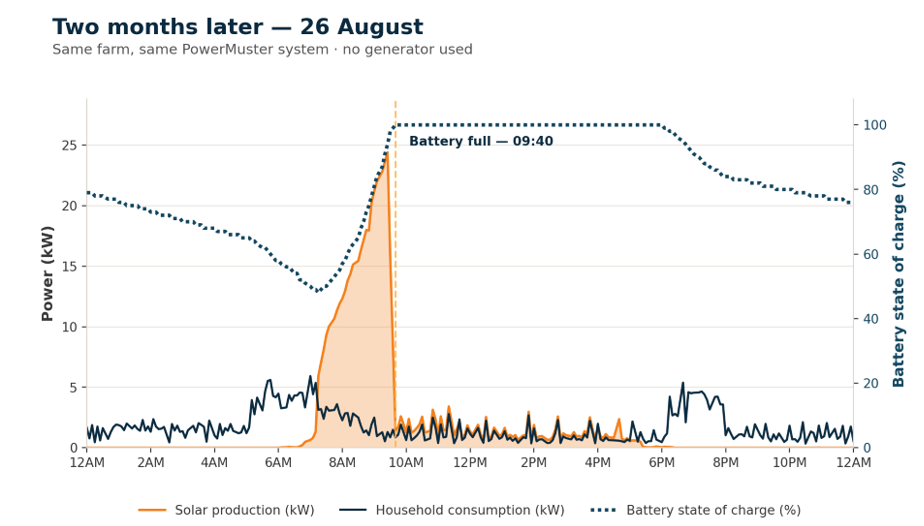 The trend is exactly what you’d expect heading out of winter: the array wakes up earlier, climbs faster, and the battery banks its full charge well before mid-morning — leaving even more of the day’s remaining sunlight to run the farm, not just the house. By spring and summer, this same system fills faster still, with far more midday headroom to spare.
Why this matters for rural WA
Grid extension to remote WA properties is expensive or simply unavailable, and diesel generators are noisy, require fuel runs, and cost real money to keep running. This case study isn’t a marketing simulation — it’s what one real PowerMuster Farm system logged on an ordinary working day, in ordinary winter weather, on an ordinary family farm.
- No grid connection, and none needed.
- The backup generator stayed off — even on the shortest, cloudy day of the year.
- The battery filled early enough to absorb farm activity — sheds, pumps, tools — without ever touching reserve capacity.
- Performance only improves from here: just two months closer to summer, the same system was already filling the battery over an hour earlier in the day.
This is the situation most PowerMuster clients across rural Western Australia are already living: independent, reliable power, drawn from the sun and the array’s east-west spread across the day, without relying on the grid or burning fuel to get through winter.
Curious what a PowerMuster system would look like on your property? Get in touch with the Solar Suite PowerMuster team to talk through your site.