
June 17, 2026

PowerMuster vs Western Power SPS: Understanding Your Off-Grid Options in Rural WA
Solar Suite / PowerMuster
Rural landholders in Western Australia’s Southwest and Wheatbelt regions increasingly find themselves at an energy crossroads. Western Power is actively rolling out its Standalone Power System (SPS) program, with a stated long-term goal of progressively removing poles and wires from rural properties across the state. At the same time, Solar Suite’s PowerMuster system offers farmers a genuine alternative path to energy independence — one where the client owns the asset, chooses the system, and is not subject to the decisions or timetable of a state utility.
This article presents an honest, side-by-side comparison of the two options. Understanding the key differences helps clients make an informed decision about the best path forward for their property.
What Is the Western Power SPS Program?
Western Power’s Standalone Power System (SPS) program replaces traditional poles-and-wires infrastructure with an on-site solar-battery system with a diesel backup generator. The program is part of a stated 30-year plan to progressively decommission approximately 15,000 km of overhead powerlines across regional WA, beginning with properties on the edges of the network or in areas where infrastructure is due for replacement.
Western Power has been explicit about the long-term direction: the SPS rollout is the start of a decades-long transition away from the traditional rural network. Over 320 SPS units have been installed to date, with a commitment to continuing the rollout across the Wheatbelt, Great Southern, Mid-West, and South West regions for the foreseeable future. The WA Government has committed to deploying at least 1,000 systems and has described the program as a transition to a new generation mix of systems.
How the Western Power SPS Works
Under the Western Power SPS asset replacement program, Western Power installs and owns the SPS unit on the farmer’s property. The unit combines solar panels, a lithium battery, and a diesel backup generator. Western Power covers the upfront cost of the unit, as well as all ongoing maintenance, fault response, and eventual replacement.
Crucially, the farmer does not own the system. Western Power retains ownership of the SPS unit, and, for safety and legal reasons under the Energy Operators (Powers) Act 1979 (WA), only authorised Western Power personnel are permitted to access or work on it. Unauthorised access carries a fine of up to $2,000.
After the SPS is installed, the customer continues to receive a Synergy electricity bill at the standard unit rate — the same as a grid-connected customer. The electricity cost itself does not change even though the supply method has changed.
The Real Cost of the Western Power SPS: What It Costs the System
While the SPS unit is installed at no direct upfront cost to the farmer, this does not mean the system is free — it means the cost is borne by Western Power (and by extension, all electricity ratepayers through the tariff equalisation contribution built into network charges). Published figures from Western Power’s own SPS program provide useful context: 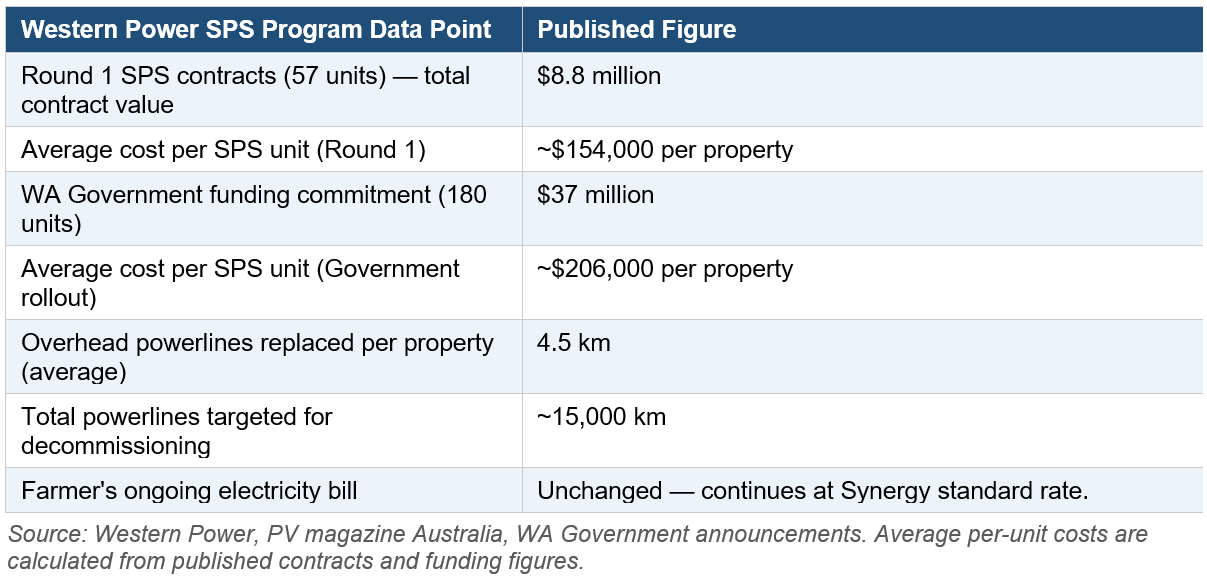
In other words, while the farmer pays nothing upfront for a Western Power SPS, the actual system cost borne by the State — ranges from approximately $150,000 to over $200,000 per property. The farmer then continues paying Synergy’s standard electricity tariff for the remainder of their time on the system, with no reduction in their electricity bill as a result of switching to the SPS.
Western Power’s Long-Term Agenda: Getting Farmers Off the Grid
Western Power has been transparent about what drives the SPS program. The primary motivation is not the convenience of rural customers — it is the cost and complexity of maintaining ageing infrastructure across WA’s vast rural network. Replacing poles and wires with SPS units is cheaper for Western Power than refurbishing the existing network and progressively reduces the territory it must maintain.
Western Power has described the SPS rollout as the start of a 30-year plan, with the long-term aim of entirely removing the poles and wires from participant properties. Once an SPS is installed, the existing overhead network serving that property is decommissioned. Customers are notified that if they require a new grid connection at the same location within 10 years of decommissioning, they will be offered a connection — but any future connection will be delivered via a new SPS rather than a reinstated grid connection.
The practical implication for farmers is this: once Western Power installs an SPS on your property, the grid connection is gone. You are moved off the network permanently, on Western Power’s schedule and under Western Power’s terms — not by choice, and not necessarily at the time that best suits your operation.
What the Western Power SPS Cannot Do for a Working Farm
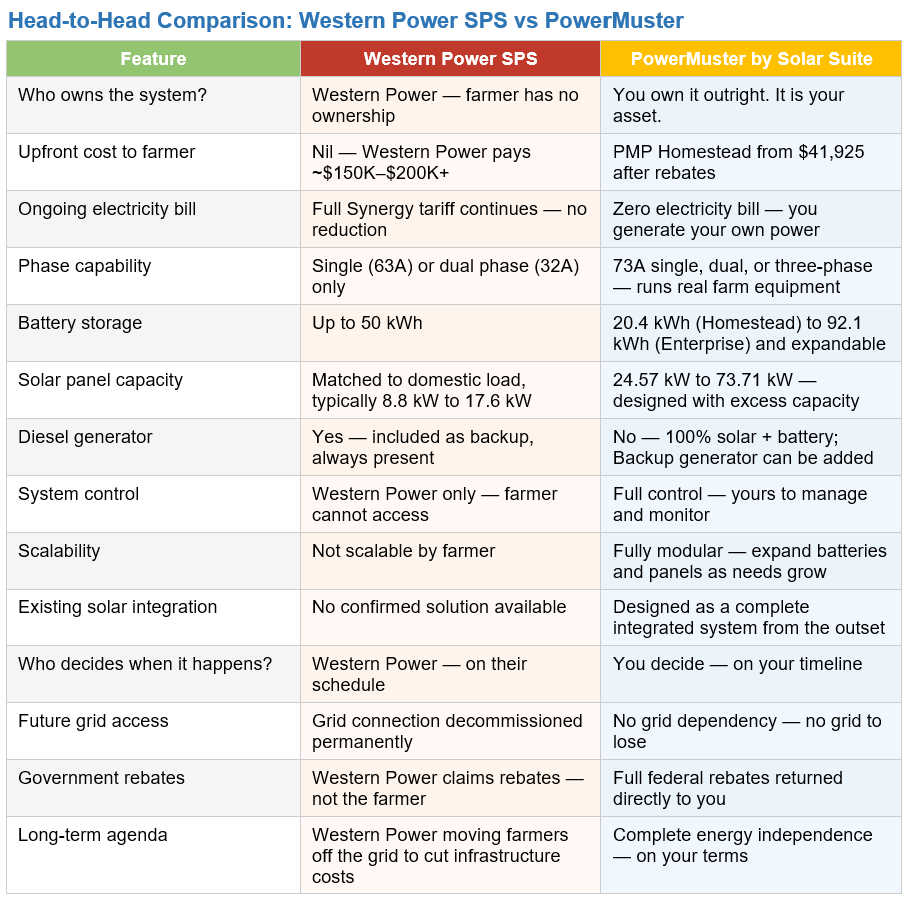
The Western Power SPS is designed to meet standard domestic supply — 63 amps single phase, with up to 40 amps of inrush. This specification is adequate for a residential homestead, but it is not designed to power the three-phase loads that are standard in a working agricultural operation. Key limitations include:
- Single-phase supply only — not capable of running three-phase motors, irrigation pumps, workshop equipment, or grain handling infrastructure without costly phase converters
- Maximum 63A supply — may be insufficient for intensive agricultural operations with high simultaneous load requirements
- Capped at 50 kWh battery storage — the largest Western Power SPS unit tops out at 50 kWh, compared to PowerMuster’s 92 kWh Enterprise configuration
- No client control over the system — Western Power owns, operates, and controls the SPS. The farmer cannot adjust, expand, or modify the unit without Western Power’s authorisation
- Diesel backup generator included — the Western Power SPS includes a diesel generator as backup, which introduces ongoing fuel and maintenance requirements managed by Western Power, but still present on your property
- Cannot integrate existing solar panels — Western Power states that SPS integration with existing customer solar panels is still being trialled, with no confirmed solution currently available
The Ongoing Bill: Why the Western Power SPS Doesn’t Solve the Cost Problem
One of the most significant practical differences between the Western Power SPS and PowerMuster is what happens to the electricity bill after installation. Under the Western Power SPS model, the farmer continues to pay Synergy’s standard retail tariff for every kilowatt-hour consumed — the same as any other grid-connected customer. Western Power has explicitly confirmed this: the cost per unit of electricity is the same as for network-connected customers, and if electricity usage stays the same, so will the bill.
This means that despite a system costing more than $150,000 being installed on the property, the farmer derives no direct financial benefit from the energy transition. Synergy’s standard residential tariff is currently 32.37 cents per kWh, with a daily supply charge of $1.1605. Electricity prices in WA have increased by more than 37% in the year to February 2026 following the removal of the government’s $400 annual electricity credit. There is no mechanism within the Western Power SPS program for the farmers to reduce their exposure to rising tariffs.
PowerMuster eliminates the electricity bill. Once a PowerMuster system is installed, the property generates and stores its own solar power. There is no Synergy tariff, no daily supply charge, and no exposure to future grid price increases. Over a system lifespan of 25–30 years, the difference in total electricity cost between the two approaches is substantial.
Government Rebates: Who Actually Benefits?
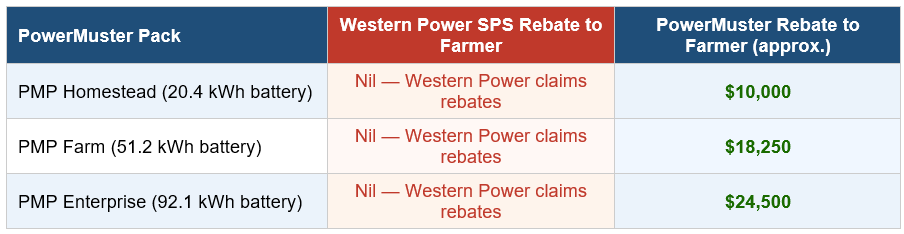
Under the federal Cheaper Home Batteries Program and the solar panel STC scheme, significant rebates are available to property owners who install eligible solar and battery systems. Under the Western Power SPS model, Western Power installs the system and claims these rebates on its own behalf — the farmer, who does not own the asset, does not receive any rebate entitlement.
Under PowerMuster, the situation is entirely different. Solar Suite installs the system on behalf of the client, lodges the STC claims for both the solar panels and the battery after installation, and returns the rebate directly to the client. For the three PowerMuster packs, the combined federal rebates currently available are approximately:
The Fundamental Difference: Passive Transition vs Active Independence
The Western Power SPS program and PowerMuster represent two fundamentally different relationships between a farmer and their energy supply. Under the Western Power model, the farmer becomes a passive participant in a utility-led network transition. The system is installed when Western Power decides to do so, sized to a specification determined by Western Power, on infrastructure owned by Western Power, at a tariff set by Western Power and the government. The farmer’s grid connection has been permanently removed, and the long-term direction — progressively moving rural customers off the poles-and-wires network — is driven by Western Power’s infrastructure economics, not by the farmer’s energy needs.
Under PowerMuster, the farmer is the decision-maker. They choose when to invest, which pack suits their operation, and they own the asset outright. The system is designed for real agricultural loads — three-phase equipment, irrigation, refrigeration, and workshop machinery — not just domestic supply. The federal rebates flow back to the client, not to a state utility. And once installed, the farmer’s power costs are eliminated, not simply maintained at the current Synergy rate.
There is a further consideration: Western Power’s stated long-term agenda is to progressively decommission the rural poles-and-wires network over 30 years. Farmers who are eventually selected for the SPS program will be transitioned off the grid on Western Power’s terms. Farmers who invest in PowerMuster now transition on their own terms — with a system they own, sized to their actual needs, with a rebate in their pocket rather than in Western Power’s balance sheet.
The Bottom Line
- Western Power SPS: Free to install, but you continue paying Synergy’s full electricity tariff; you don’t own the system, and you have no control over when or how the transition happens
- PowerMuster: You invest in your own system, eliminate your electricity bill permanently, receive up to $26,750 in federal rebates, and own an asset that grows with your operation
- Western Power’s direction is clear: rural WA will eventually go off-grid. The question is whether that happens on the utility’s timeline and terms, or yours
- PowerMuster is the only option that delivers three-phase power, zero ongoing electricity costs, client ownership, and full federal rebate entitlement
PowerMuster by Solar Suite | Purpose-built off-grid solar for Australian farming operations. Contact your PowerMuster agent to discuss the right Pack for your property.
PowerMuster & Solar Suite
[1] PowerMuster Rural Solutions — Solar Suite — https://www.powermuster.com.au/rural-solutions
[2] PowerMuster Components — Solar Suite — https://www.powermuster.com.au/components
Western Power SPS Program
[3] Stand Alone Power Systems — Western Power — https://www.westernpower.com.au/resources-education/our-network-the-grid/grid-technology/stand-alone-power-system/
[4] Stand-Alone Power Systems FAQs — Western Power — https://www.westernpower.com.au/resources-education/faqs/stand-alone-power-systems/
[5] Western Power Completes Deployment of 52 SPS — pv magazine Australia — https://www.pv-magazine-australia.com/2020/10/27/western-power-completes-deployment-of-52-stand-alone-power-systems-in-australia-first/
[6] Western Power Launches Round 2 of SPS Rollout — pv magazine Australia — https://www.pv-magazine-australia.com/2020/02/25/western-power-launches-round-2-of-stand-alone-power-system-rollout/
[7] $37 Million Standalone Power System Rollout in WA — Energy Magazine — https://www.energymagazine.com.au/37-million-standalone-power-system-rollout-in-wa/
[8] Western Australia Putting 1,000 SPS into Remote and Rural Areas — Energy Storage News — https://www.energy-storage.news/western-australia-putting-1000-pv-plus-battery-standalone-power-systems-into-remote-and-rural-areas/
WA Electricity Tariffs
[9] Synergy Electricity Rates Perth 2026 — Perth Solar Warehouse — https://perthsolarwarehouse.com.au/synergy-electricity-rates-perth/
[10] Household Electricity Pricing — WA Government — https://www.wa.gov.au/organisation/energy-policy-wa/household-electricity-pricing
Product Specifications
[11] Deye High-Voltage LiFePO4 Battery — https://www.deyeinverter.com/product/lithium-battery-1/sn29kbtl-high-voltage-lithium-battery.html
[12] Deye SUN-40/50K-SG01HP3 Three-Phase Hybrid Inverter — https://www.deyeinverter.com/product/three-phase-hybrid-inverter-1/sun-40-50k-sg01hp3-eu-bm4.html
[13] TCL Solar Half-Cut N-Type Bifacial Double Glass Panel (HSM-ND72-GF580~605) — https://www.tclsolar.com