May 13, 2026

Australian Solar & Battery Incentives in 2026
What They Mean for Your PowerMuster Investment
Solar Suite / PowerMuster | Updated for incentive rates effective 1 May 2026
 The Federal Government continues to offer substantial upfront incentives on solar and battery storage.
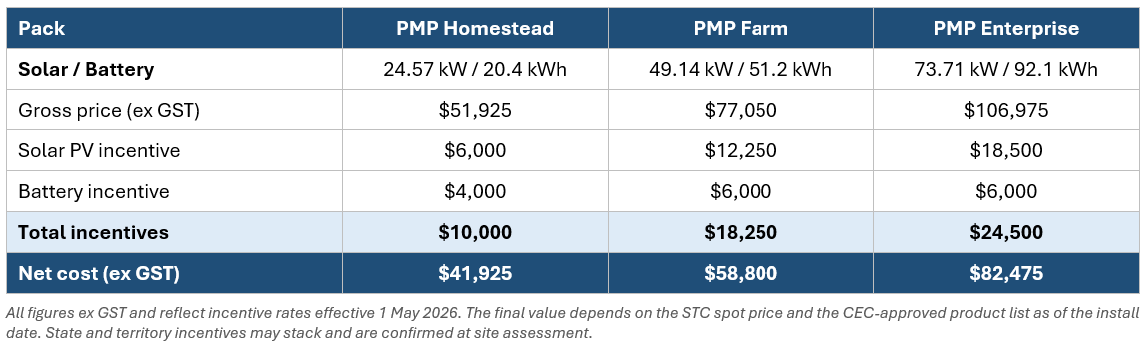
Combined, the Federal Cheaper Home Batteries Program and the long-running Small-scale Renewable Energy Scheme (SRES) for solar PV (panels) deliver between $10,000 and $24,500 off the cost of a PowerMuster system.
Solar Suite claims both incentives on your behalf after installation and returns them to you, reducing your net out-of-pocket investment.
The Two Incentives at a Glance
Solar PV Incentive (STCs):
When your panels are installed, a claim is lodged with the Clean Energy Regulator, who then issues a number of Small-scale Technology Certificates (STCs) to you upfront. The number of STCs issued scales with system size, your location zone, and the number of years remaining until the SRES scheme closes on 31 December 2030.
For 2026 installations, the deeming period is five years; it drops by one year each January, reducing the solar incentive by roughly $50 per kW of panels for each year of delay.
STCs have value because large polluters, such as coal-fired power stations, are required by law to buy a set number of STCs every 3 months to offset the Carbon they emit. If they don’t buy the full number of STCs, they must pay a $40 penalty for each STC they are short.
Solar Suite sells your STCs on your behalf and returns the proceeds to you.
The STC price never exceeds the $40 penalty per STC, and typically sits a few dollars below $40 due to Regulator administration fees and supply and demand
Battery incentive (Cheaper Home Batteries Program):
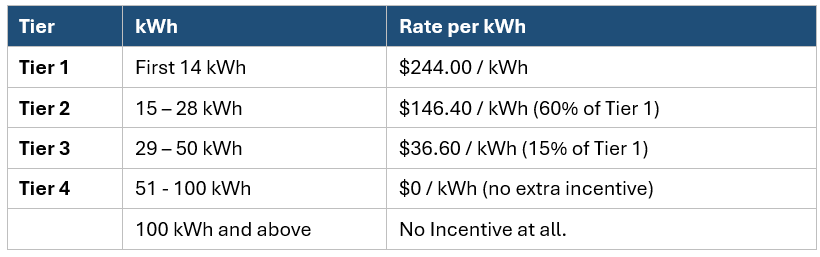
From 1 May 2026, the battery incentive is paid on a tiered $/kWh basis but is only paid on the first 50kWh of installations of up to 100 kWh, capped.
What This Means for the Three PowerMuster Packages
All three PowerMuster packages qualify for both incentives. The Homestead captures the highest-rate Tier 1 and Tier 2 battery bands; the Farm and Enterprise both reach the 50-kWh cap and therefore receive the maximum federal battery incentive.
The PV incentive scales directly with array size.
How Solar Suite Manages the Process
Federal incentive programs involve compliance documentation, approved product lists, accreditation requirements, tiered calculations, and STC lodgement through the Clean Energy Regulator’s REC Registry. Solar Suite manages the process on your behalf, as a standard part of every PowerMuster installation:
- System designed and installed by an SAA-accredited installer using CEC-approved Deye batteries
- Solar Suite lodges both PV and battery STC claims and handles all compliance paperwork
- STCs are settled by the Clean Energy Regulator (typically under three months) and traded by Solar Suite
- The incentive value is returned to you after installation — not applied at the point of sale
Why Timing Matters
Two reductions are already locked in by the Federal Government. The PV deeming period drops one year every January, cutting the solar incentive by approximately 20% each year.
The battery program is also scheduled for further rate cuts before it closes on 31 December 2030. The 1 May 2026 step-down demonstrates that the Government can also make unscheduled changes.
Remember, your claim can only be made when your system is installed and commissioned. Acting now locks in the highest applicable rates; delay risks a smaller incentive, tighter eligibility, or a restructured program.